1 in 3 adults don't get enough sleep.
Source: CDC, 2024.
Most of them have already tried the obvious fixes. Very few have controlled the two things that actually decide what a night feels like — light and sound.
Two inputs your body reads while you fall asleep.
Sleep is affected by things that are hard to change — stress, schedule, caffeine, age. It's also affected by two things that can be changed tonight: how much light reaches your eyes, and what you hear. Those two are the only physical inputs your body reads while you're trying to fall asleep. VOID closes both.
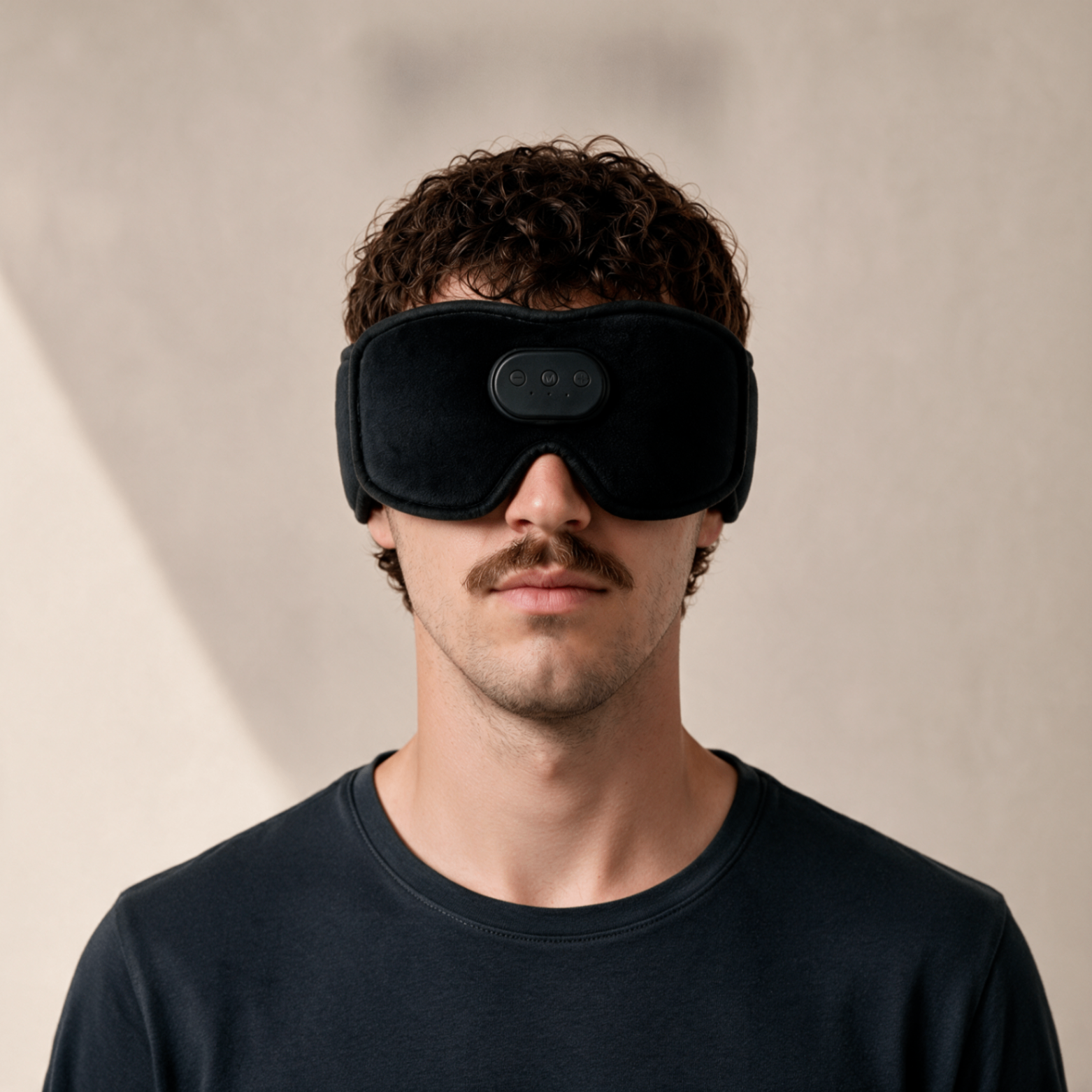
Closing your eyes doesn't stop it.
Light reaching the eye suppresses melatonin, the signal the body uses to start sleep. Research has found that exposure to ordinary room light before bed delays melatonin onset in nearly every person tested, and cuts roughly 90 minutes off how long it stays elevated.
The part most people don't know: closing your eyes doesn't stop it. Studies measuring light delivered through closed eyelids found melatonin suppressed by roughly a third to over half, depending on the time of night. Eyelids reduce light. They don't block it.
These findings describe the effects of light and darkness. VOID creates darkness.
A silent room isn't silent.
It has traffic, HVAC, a partner, a neighbor — irregular sounds that pull you back toward waking. Steady background sound covers those irregularities so there's nothing to react to.
Pink noise is the most researched profile for this, associated with more stable sleep across the night. Brown noise sits lower and is widely preferred for masking traffic and snoring. Guided breathing sessions give the mind one thing to follow instead of the day it just had.
VOID plays all of it, over Bluetooth, from whatever app you already use.
Half the problem, or the whole thing.
Nothing
Eyes closed in a dark-ish room. Light still passes through the eyelids and keeps suppressing melatonin. Every irregular noise in the building still lands. Both inputs are uncontrolled.
A regular eye mask
Handles light, and only if it seals. Most masks leak at the nose bridge, which is exactly where light gets in. And it does nothing about sound — the room is just as loud with a mask on. Half the problem solved, at best.
Headphones or earbuds
Handles sound, does nothing about light. Earbuds hurt within an hour and fall out. Over-ear headphones make side sleeping impossible. Neither is designed to be worn unconscious for eight hours.
VOID Recovery Mask
Full blackout, contoured to seal at the nose bridge. Flat speaker panels over the ears with nothing inserted — thin enough to lie on your side. Both inputs closed, in one thing you can actually sleep in.
What it's made of.
- 01
Contoured blackout seal at the nose bridge.
- 02
Flat side speakers for side sleepers.
- 03
Soft breathable fabric.
- 04
USB-C charging.
A few things people ask.
No. Research has found light still reaches through closed eyelids and suppresses melatonin. Full blackout is a different condition.